

Topic modeling is a powerful technique in Natural Language Processing (NLP) that uncovers hidden thematic structures in large collections of text data, enabling deeper insights and better decision-making.
Understanding Natural Language Processing (NLP)
Natural Language Processing (NLP) is a branch of artificial intelligence that focuses on the interaction between computers and humans through natural language. It involves the development of algorithms and models that enable machines to understand, interpret, and generate human language in a way that is both meaningful and useful. NLP encompasses a wide range of tasks, including sentiment analysis, language translation, speech recognition, and text summarization.
The importance of NLP in data analytics cannot be overstated. In today's data-driven world, a significant portion of information is stored in unstructured text formats such as emails, social media posts, customer reviews, and reports. NLP provides the tools to extract valuable insights from this unstructured data, transforming it into structured, actionable intelligence.
Introducing Topic Modeling
As the volume of unstructured text data continues to grow exponentially, organizations across industries are turning to advanced NLP techniques like topic modeling to extract meaningful patterns and themes. Topic modeling is an unsupervised machine learning technique used to identify latent topics within a collection of documents. By analyzing the distribution of words, it groups related content into clusters that represent distinct themes. Popular algorithms include:
- Latent Dirichlet Allocation (LDA)
- Non-Negative Matrix Factorization (NMF)
- Latent Semantic Analysis (LSA)
Analyzing Amazon Reviews: A Practical Example
To illustrate the power of topic modeling, let's consider a practical example: analyzing customer reviews on Amazon. With millions of reviews across countless products, this vast dataset is a goldmine of consumer insights, but its unstructured nature makes manual analysis impractical. By applying topic modeling, we can automatically uncover recurring themes and topics within these reviews, such as product quality, shipping experiences, or customer service issues.
In the sunburst chart, hover over any segment to view its associated topics. The central circle summarizes all documents collectively. As you move outward along a leg, the topics become increasingly specific — starting at section 304, the dominant descriptor is "food," which splits into animal food versus human food, and each side subdivides further into specific food types. Comparing the two sides of the chart shows a clear separation between solid consumables and liquid consumables. This layout illustrates how a broad theme is progressively refined into finer sub-topics as you explore the chart.
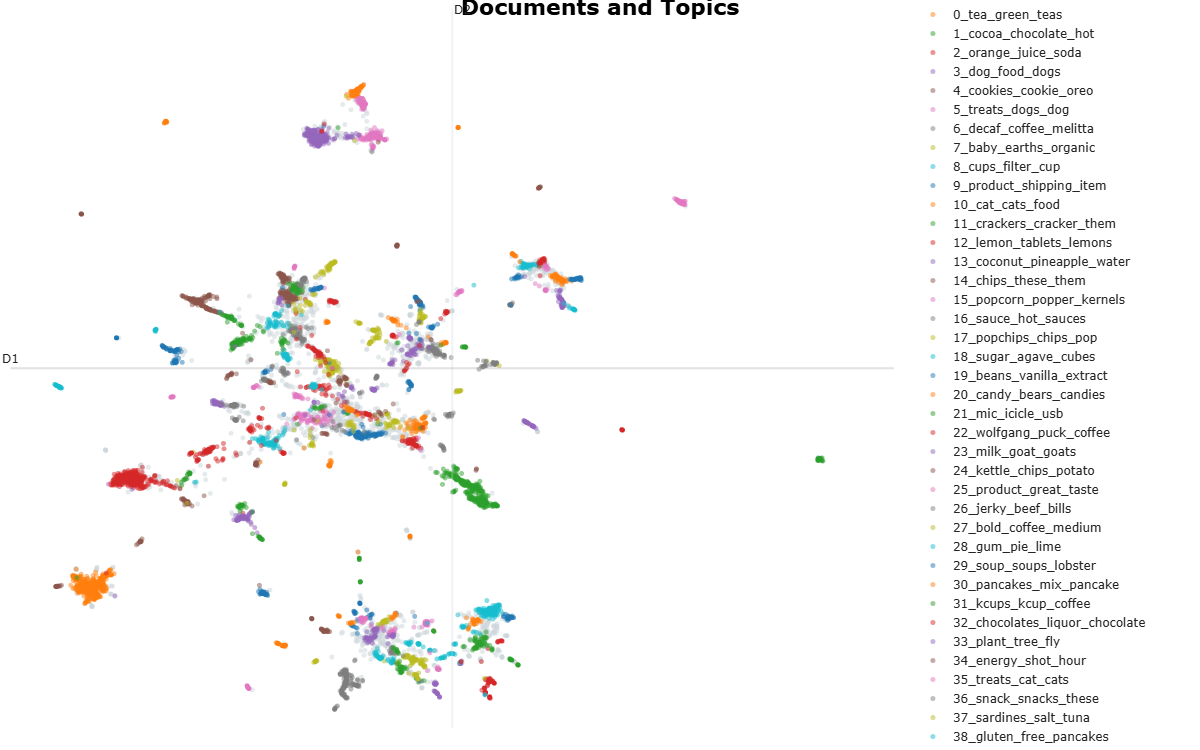
The sunburst chart is created by analyzing hidden state representations of the documents learned during the model training process. Modern NLP typically focuses on using deep neural networks to learn an embedding or hidden state representation of the language relationships within data. An example of this hidden state for our Amazon reviews is shown below — it represents the contextual meaning of each document and helps align each document's meaning to an area in space where similar documents are close together, while dissimilar documents are further apart.
At Phronesis Analytics, we have worked on projects that analyze natural language text to help businesses understand customer feedback, maintenance trends, survey feedback, and much more. By identifying dominant topics, companies can pinpoint areas for improvement, tailor their marketing strategies, and enhance customer satisfaction.
Key Applications of NLP
- Document Analysis
- Recommendation Systems
- Trend Identification
Challenges and Innovations
While topic modeling offers immense value, challenges such as selecting the optimal number of topics, handling noisy data, and interpreting results remain. At Phronesis Analytics, we leverage cutting-edge techniques like dynamic topic modeling and contextual embeddings to address these issues, ensuring robust and actionable insights.
Scalability
Processing large datasets efficiently to uncover topics in real-time for dynamic industries.
Interpretability
Ensuring results are meaningful and actionable through advanced visualization and human-in-the-loop approaches.
Looking Ahead
As NLP continues to evolve, topic modeling will play a pivotal role in unlocking the value of unstructured data. At Phronesis Analytics, we are committed to pushing the boundaries of this technology, helping our clients gain a competitive edge through deeper, data-driven insights.
Sitting on a pile of customer feedback, reviews, or survey text?
This is exactly the kind of unstructured data we help small and mid-sized businesses turn into something usable — no data science team required. Let's talk about what's in yours.